Getting a Green Card can mark the beginning of a new financial life in the United States. Even if you have years of financial history in another country, you may discover that you have little or no U.S. credit history.
Learning how to build credit after getting a Green Card can help when you eventually want to apply for a credit card, finance a vehicle, rent an apartment, or qualify for certain loans.
Building credit does not happen overnight. The goal is to establish accounts that can be reported to the major credit bureaus and then manage those accounts responsibly over time.
This guide explains practical ways to start building U.S. credit while avoiding some of the most common mistakes made by newcomers.
1. How to Build Credit After Getting a Green Card
A simple approach is to start small.
You do not need several credit cards or a large loan to begin establishing credit history.
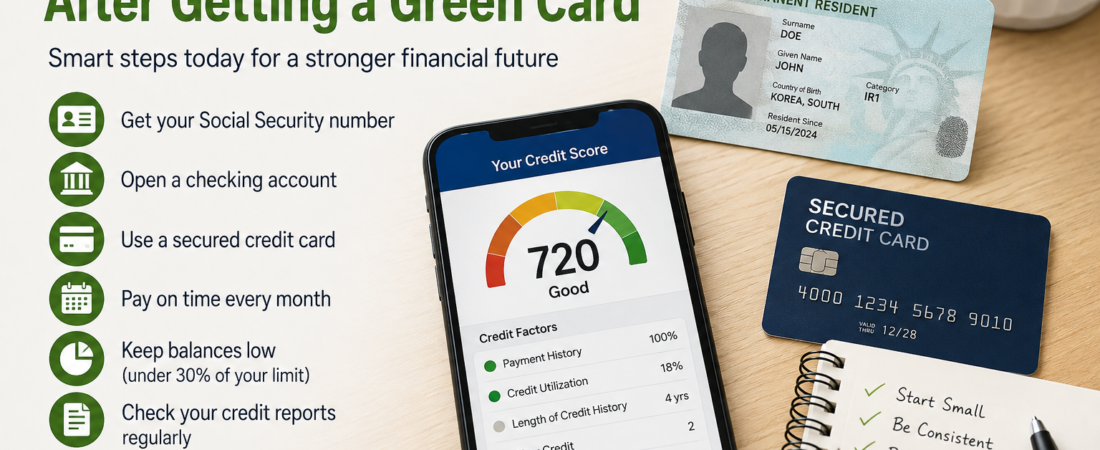
A practical starting plan may look like this:
- Get a Social Security number if you are eligible and do not already have one.
- Open a U.S. checking account.
- Review credit products designed for people with limited credit history.
- Open one appropriate credit account.
- Use it for small purchases.
- Pay the bill on time every month.
- Keep balances manageable.
- Monitor your credit reports.
Consistency is more important than trying to build credit quickly.
2. What Is a Credit Score?
A credit score is a number calculated using information contained in your credit report.
Lenders may use credit scores and other information when deciding whether to approve applications and what terms to offer.
Credit scores are not all identical. Different scoring models and different versions of those models may produce different scores.
This is why the score you see in one app may not always match the score a lender uses.
Rather than focusing on a single number every day, concentrate on building responsible long-term credit habits.
3. You May Not Have a Credit Score Immediately
Receiving a Green Card does not automatically create a U.S. credit score.
Likewise, opening a checking account by itself generally does not establish the type of credit history used by traditional credit scoring models.
You usually need activity on accounts that are reported to consumer reporting companies.
If you are new to the United States, having little or no credit history is normal.
Your first goal should be establishing a legitimate credit account that you can manage comfortably.
4. Consider a Secured Credit Card
A secured credit card can be one option for someone who has limited or no U.S. credit history.
With many secured cards, you provide a refundable security deposit. The deposit may help determine your credit limit.
For example, a card might require a deposit before the account is opened.
The card can then generally be used for purchases like a regular credit card, subject to its terms.
Before applying, check:
- Annual fee
- Interest rate
- Required security deposit
- Credit limit
- Whether the issuer reports to major credit bureaus
- Upgrade or graduation options
- Deposit refund rules
Do not assume every secured card has the same terms.
5. Use the Card for Small Regular Purchases
Once you have a credit card, you do not need to spend heavily to build credit.
Consider using it for one or two predictable expenses, such as:
- Gas
- Groceries
- A mobile phone bill
- A small subscription
The purpose is to establish a record of responsible account management, not to increase your spending.
Avoid buying something simply because credit is available.
6. Pay Every Bill on Time
Payment history is an important factor in commonly used credit scoring models.
Create a system that makes missed payments unlikely.
You can:
- Enable automatic payments
- Set calendar reminders
- Turn on payment notifications
- Check your account regularly
If you use automatic payment, make sure your bank account has enough money to cover the payment.
A simple strategy is to pay the full statement balance by the due date whenever possible.
7. Understand Credit Utilization
Credit utilization generally compares the revolving credit balance being reported with the available credit limit.
For example, if a card has a $1,000 credit limit and a $200 balance is reported, the utilization on that card would be 20%.
Lower utilization can generally be better for credit scoring than consistently using most or all of your available revolving credit.
You may hear advice to stay below a particular percentage such as 30%. Do not treat a single percentage as a magic cutoff.
A better habit is simply to avoid carrying unnecessarily high balances relative to your available credit.
8. Do Not Carry Interest Just to Build Credit
One common credit myth is that you must carry a balance from month to month and pay interest to improve your credit score.
You generally do not need to pay credit card interest simply to establish positive payment history.
If possible, pay your statement balance in full by the due date.
This can allow you to use the card responsibly without turning credit building into an expensive process.
9. Avoid Applying for Too Many Cards
When someone has little credit history, it can be tempting to apply for many cards hoping that one will approve the application.
That can be a mistake.
Credit applications can result in hard inquiries, and opening several new accounts within a short period may not be helpful.
Research eligibility requirements before applying and start with a product appropriate for your credit profile.
One manageable account can be enough to begin.
10. Consider Becoming an Authorized User Carefully
Another possible way to establish credit history is becoming an authorized user on another person’s credit card.
However, this should only be considered with someone you trust and after understanding how the issuer reports authorized-user activity.
The primary cardholder’s account management can potentially affect the information associated with the authorized user.
Do not pay strangers to add you as an authorized user.
Be especially cautious of companies selling access to other people’s credit card accounts as a quick credit-building shortcut.
11. Check Your Credit Reports
Your credit reports contain information about credit accounts and payment history reported in your name.
Reviewing your reports can help you identify:
- Accounts you recognize
- Incorrect personal information
- Unexpected balances
- Late payments
- Accounts you did not open
- Possible identity theft
The federally authorized website for free credit reports is AnnualCreditReport.com.
Be careful with websites that imitate official credit-report services or require unnecessary paid subscriptions.
12. What If You Find an Error?
If you find inaccurate information on a credit report, do not simply ignore it.
You can dispute incorrect information with the appropriate credit reporting company and, when appropriate, the company that provided the information.
Keep records of your dispute and supporting documents.
Do not pay a company simply because it promises to remove accurate negative information from your credit report.
Accurate negative information generally cannot be legitimately erased just because you pay a credit-repair company.
13. Protect Yourself From Credit-Building Scams
New immigrants and people without established credit can be attractive targets for scams.
Be cautious of anyone promising:
- An instant 800 credit score
- A completely new credit identity
- Guaranteed deletion of accurate negative information
- Guaranteed loan approval
- A special government credit number
- Credit repair with no explanation of the process
Never use someone else’s Social Security number or false information on a credit application.
Legitimate credit building takes time.
14. How Long Does Building Credit Take?
There is no single timeline that applies to everyone.
Your progress can depend on the accounts you have, how they are reported, payment history, balances, account age, and the scoring model being used.
Do not become discouraged if you do not see a high score immediately.
The first objective is to establish accurate credit history and manage it consistently.
Think in terms of months and years rather than days.
15. Your First-Year Credit Checklist
Use this checklist as a simple roadmap:
- Get your Social Security number if applicable
- Open a checking account
- Research a beginner or secured credit card
- Check fees before applying
- Confirm whether the account reports to credit bureaus
- Start with one manageable account
- Use the card for small purchases
- Pay every bill on time
- Avoid unnecessary interest
- Keep balances manageable
- Avoid excessive applications
- Review your credit reports
- Dispute genuine errors
- Protect your personal information
You do not need to complete everything immediately.
Building a strong financial foundation gradually is usually better than trying to rush the process.
Frequently Asked Questions
Does getting a Green Card give me a credit score?
No. Permanent resident status itself does not automatically create a credit score. Your credit history generally develops through financial accounts and activity reported to consumer reporting companies.
Do I need a Social Security number to build credit?
An SSN is commonly used by lenders and credit reporting companies to identify consumers, although specific requirements vary by financial institution and product.
Will a debit card build credit?
Using a traditional debit card generally does not work like borrowing on a credit card and normally does not establish conventional revolving credit history.
Should I get several credit cards to build credit faster?
Usually, there is no need to open several cards immediately. Starting with one appropriate account and managing it responsibly can be a simpler strategy.
Is a secured credit card a real credit card?
Yes. A secured credit card is a credit card, although it generally requires a security deposit. Terms vary by issuer.
Do I need to leave a balance on my card?
No. You do not need to intentionally carry a balance and pay interest simply to build credit.
Can I build an excellent credit score in one month?
Credit history develops over time. Be cautious of anyone guaranteeing a specific high score within an extremely short period.
Final Thoughts
Understanding how to build credit after getting a Green Card can help you establish a stronger financial foundation in the United States.
Start slowly. One appropriately chosen credit account, consistent on-time payments, manageable balances, and regular credit-report reviews can be more useful than opening multiple accounts at once.
Most importantly, do not spend money or pay unnecessary interest simply to chase a credit score.
Good credit is generally the result of responsible financial behavior repeated over time. Focus on building sustainable habits, protecting your personal information, and checking your credit reports for accuracy as your U.S. credit history develops.