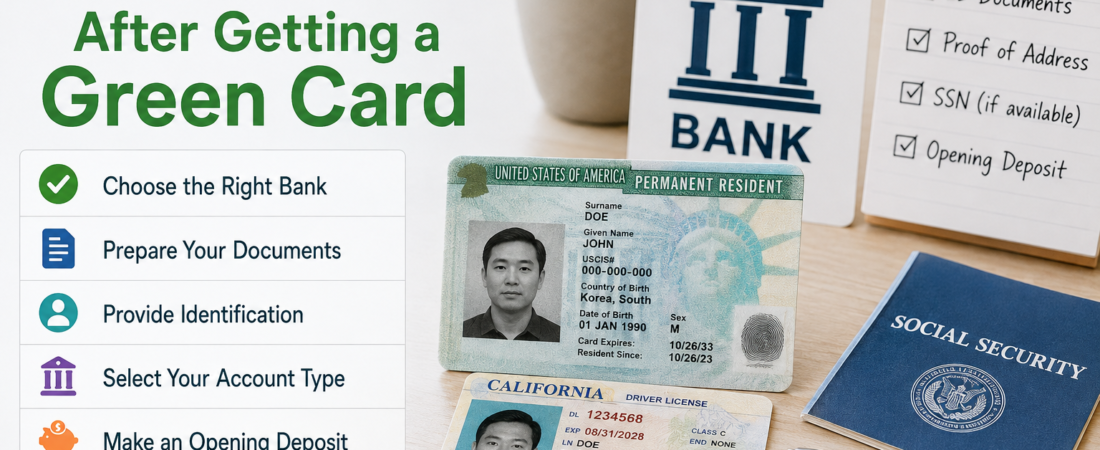
Getting a Green Card is the beginning of a new financial life in the United States. One of the most useful things you can do after becoming a permanent resident is open a U.S. bank account.
Learning how to open a bank account after getting a Green Card can make it easier to receive your paycheck, pay bills, use a debit card, save money, and begin establishing your financial history in the United States.
The process is usually straightforward, but choosing the right account matters. Fees, minimum balances, ATM access, overdraft policies, and identification requirements can vary by financial institution.
This guide explains what to prepare, what type of account to consider, and what to check before opening your first U.S. bank account.
1. How to Open a Bank Account After Getting a Green Card
Start by comparing banks and credit unions available in your area or online.
Do not choose an account based only on the bank’s name. Compare monthly fees, minimum balance requirements, ATM availability, online banking features, and whether fees can be waived through direct deposit.
Once you choose a financial institution, you may be able to apply online or visit a branch.
The bank must verify your identity, so be prepared to provide personal information and acceptable identification.
2. Bank Account Opening Checklist
Before starting your application, prepare the information and documents the financial institution may request.
Your checklist may include:
- Your full legal name
- Date of birth
- Current U.S. residential address
- Social Security number or another accepted taxpayer identification number
- Green Card
- Driver’s license, state ID, passport, or another accepted identification document
- Proof of your current address if requested
- Money for an opening deposit if the account requires one
- Phone number and email address
Requirements vary by financial institution.
If you do not have one of the requested documents, ask the bank whether it accepts another form of identification.
3. Do You Need a Social Security Number?
A Social Security number is commonly requested when opening financial accounts, but not having an SSN does not necessarily mean that you cannot open an account.
Financial institutions have identity-verification requirements and may accept other forms of identification or taxpayer identification information depending on their policies and the type of account.
If you recently became a permanent resident and have not received your Social Security number yet, contact the financial institution before applying and ask what alternatives it accepts.
Do not enter a false or borrowed Social Security number on a bank application.
4. Checking Account vs. Savings Account
Many newcomers should understand the difference between checking and savings accounts before applying.
Checking Account
A checking account is generally designed for everyday transactions.
You may use it for:
- Direct deposit from your employer
- Debit card purchases
- ATM withdrawals
- Online bill payments
- Rent and utility payments
- Transfers to other accounts
Savings Account
A savings account is generally designed for money that you do not need for everyday spending.
You may use it for:
- Emergency savings
- Future purchases
- Moving expenses
- Travel savings
- A home or vehicle fund
Many people eventually use both: checking for regular spending and savings for money they want to set aside.
5. Check the Monthly Fee Before Opening the Account
Do not assume that every checking account is free.
Some financial institutions charge a monthly maintenance fee but waive it if you meet certain requirements.
For example, an account may waive its monthly fee when you:
- Receive qualifying direct deposits
- Maintain a required minimum balance
- Meet another account requirement
Always ask exactly what you must do each month to avoid the fee.
A small monthly charge can become a significant unnecessary expense over several years.
6. Watch for Overdraft Fees
An overdraft can occur when transactions exceed the available money in your checking account.
Before opening an account, ask:
- Does this account allow overdrafts?
- What happens if my balance reaches zero?
- Can a debit card transaction simply be declined instead?
- Are there overdraft or insufficient-funds fees?
- Can I receive low-balance alerts?
Some consumers prefer accounts designed to prevent spending beyond the available balance.
Understanding the rules before using your debit card can help you avoid unexpected charges.
7. Check ATM Access
ATM fees can add up quickly.
Before choosing a bank, find out how many fee-free ATMs are available near your home and workplace.
Also check whether the bank charges for using another institution’s ATM and whether the ATM owner may charge an additional fee.
If you frequently withdraw cash, a large fee-free ATM network may be more valuable than a small difference in other account features.
8. Ask About the Minimum Opening Deposit
Some accounts can be opened with little or no initial deposit, while others require a minimum amount.
The opening deposit is different from a minimum balance requirement.
Ask both questions:
How much do I need to open the account?
How much must I keep in the account to avoid fees?
Understanding the difference can prevent surprises after the account is opened.
9. What Happens at the Bank?
If you apply in person, a bank employee will usually review your application and identification.
You may be asked to provide personal information, verify your address, select the type of account you want, and make an opening deposit if required.
Before completing the application, ask the employee to explain:
- Monthly maintenance fees
- Minimum balance requirements
- ATM fees
- Overdraft policies
- Direct deposit requirements
- Savings account requirements
- Debit card availability
- Online and mobile banking features
Do not be afraid to ask questions. You are choosing a financial product and should understand its costs.
10. Set Up Direct Deposit After You Get a Job
Once you have a checking account, your employer may allow your paycheck to be deposited directly into it.
This is known as direct deposit.
Your employer may ask for your:
- Bank name
- Routing number
- Account number
- Account type
Some employers may also request a voided check or direct-deposit form.
Double-check the routing and account numbers before submitting them.
11. Protect Your Bank Account
New immigrants can be targets for financial scams because they may be unfamiliar with the U.S. banking system.
Never give your online banking password or verification code to someone who contacts you unexpectedly.
Be suspicious if someone tells you to:
- Send money immediately
- Buy gift cards
- Provide your banking password
- Give them a one-time verification code
- Deposit a check and return part of the money
- Move money to a “safe account”
If something seems suspicious, contact your bank using the phone number shown on its official website or the back of your debit card.
12. Is Your Money FDIC Insured?
When choosing a bank, check whether it is FDIC-insured.
FDIC deposit insurance generally protects eligible deposits at an insured bank if that bank fails, subject to applicable insurance limits and ownership rules.
Credit unions may instead have federal deposit insurance through the National Credit Union Administration.
Do not assume that every financial app or company offering financial services is itself an FDIC-insured bank.
Check where your money is actually being held and what deposit insurance applies.
13. Common Mistakes New Green Card Holders Should Avoid
Avoid choosing an account without checking its fee schedule.
Also avoid keeping more money than necessary in a checking account simply because you have not yet opened a savings account.
Other common mistakes include:
- Ignoring monthly maintenance fees
- Using out-of-network ATMs frequently
- Not monitoring account balances
- Sharing banking passwords
- Falling for fake-check scams
- Forgetting to update your address
- Assuming every bank has identical identification requirements
Spend a few minutes comparing accounts before applying.
14. What to Do Immediately After Opening Your Account
Once your account is active, complete this quick setup checklist:
- Activate your debit card
- Create a strong online banking password
- Enable transaction alerts
- Enable low-balance alerts
- Download the bank’s official mobile app
- Confirm your mailing address
- Set up direct deposit when available
- Review your first monthly statement
- Learn how to lock your debit card if it is lost
- Keep your account and routing numbers secure
These small steps can make your account easier and safer to manage.
Frequently Asked Questions
Can I open a bank account immediately after getting a Green Card?
Possibly. Your ability to open a particular account depends on the financial institution’s identification requirements and your available documentation.
Can I open an account without a driver’s license?
Possibly. Banks may accept other forms of identification. Ask the institution which documents it accepts before visiting a branch.
Should I open checking or savings first?
If you need an account for paychecks and everyday expenses, checking is usually the more practical starting point. Many people then add a savings account for emergencies and longer-term goals.
Will opening a checking account build my credit score?
A standard checking account is not the same as a credit account. Building U.S. credit generally involves other financial products and responsible credit activity.
Should I open accounts at several banks?
Not necessarily. For someone new to the U.S. banking system, one well-chosen checking account and possibly a savings account can be enough to start.
Final Thoughts
Understanding how to open a bank account after getting a Green Card is an important part of establishing your financial life in the United States.
Do not focus only on whether a bank will approve your application. Compare fees, minimum balances, ATM access, overdraft policies, online banking features, and deposit insurance before choosing an account.
After opening the account, set up security alerts, monitor your transactions, and learn how the account works before moving large amounts of money.
A well-managed bank account can make everyday life easier and prepare you for the next financial steps in the United States, including employment, saving, and eventually building credit.